quinta-feira, 31 de julho de 2008

The Bauhaus school was founded by Walter Gropius in Weimar
"House of Building" or "Building School") is the common term for the Staatliches Bauhaus , a school in Germany that combined crafts and the fine arts, and was famous for the approach to design that it publicized and taught. It operated from 1919 to 1933.
The Bauhaus school was founded by Walter Gropius in Weimar. In spite of its name, and the fact that its founder was an architect, the Bauhaus did not have an architecture department during the first years of its existence. The Bauhaus style became one of the most influential currents in Modernist architecture and modern design. The Bauhaus had a profound influence upon subsequent developments in art, architecture, graphic design, interior design, industrial design and typography.
The school existed in three German cities (Weimar from 1919 to 1925, Dessau from 1925 to 1932 and Berlin from 1932 to 1933), under three different architect-directors: Walter Gropius from 1919 to 1927, Hannes Meyer from 1927 to 1930 and Ludwig Mies van der Rohe from 1930 to 1933, when the school was closed by the Nazi regime.
The changes of venue and leadership resulted in a constant shifting of focus, technique, instructors, and politics. When the school moved from Weimar to Dessau, for instance, although it had been an important revenue source, the pottery shop was discontinued. When Mies van der Rohe took over the school in 1930, he transformed it into a private school. wikipédiaquarta-feira, 30 de julho de 2008

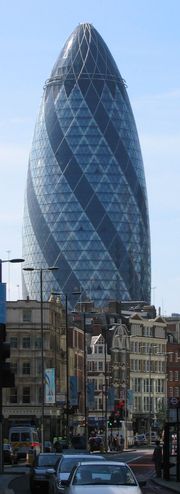
Architect Richard Rogers
Richard Rogers
(b. Florence, Italy 1933)
Richard Rogers was born in Florence, Italy in 1933. He attended the Architectural Association School in London before graduating from Yale University. He and his first wife, Sue, worked in a partnership with Norman and Wendy Foster as "Team 4". In contrast to Foster, who generated a sophisticated architecture based in technology, Rogers created lavish, enthusiastic designs. In 1970 Rogers established a partnership with the Italian architect Renzo Piano. After the completion of the Pompidou Center in Paris, the Richard Rogers Partnership was formed.
His works reject the classical past, while enthusiastically embracing a technological future with its accompanying aesthetic. Although he places emphasis on technology, he believes that it cannot be an end in itself, but must attempt to solve existing social and ecological problems.
His interest in uninterrupted interior spaces has made Rogers an heir to the functionalist tradition. His concern with total flexibility and obvious technical imagery has been termed Late Modern. However, his more recent works have returned to the images of the early Modernists, notably Mendelsohn.
References
Dennis Sharp. The Illustrated Encyclopedia of Architects and Architecture.
Architect Ludwig Mies van der Rohe
Ludwig Mies van der Rohe
Dennis Sharp. The Illustrated Encyclopedia of Architects
(b. Aachen, Germany 1886; d. Chicago, Illinois 1969)
Ludwig Mies Van der Rohe was born in Aachen, Germany in 1886. He worked in the family stone-carving business before he joined the office of Bruno Paul in Berlin. He entered the studio of Peter Behrens in 1908 and remained until 1912.
Under Behrens' influence, Mies developed a design approach based on advanced structural techniques and Prussian Classicism. He also developed a sympathy for the aesthetic credos of both Russian Constructivism and the Dutch De Stijl group. He borrowed from the post and lintel construction of Karl Friedrich Schinkel for his designs in steel and glass.
Mies worked with the magazine G which started in July 1923. He made major contributions to the architectural philosophies of the late 1920s and 1930s as artistic director of the Werkbund-sponsored Weissenhof project and as Director of the Bauhaus.
Famous for his dictum 'Less is More', Mies attempted to create contemplative, neutral spaces through an architecture based on material honesty and structural integrity. Over the last twenty years of his life, Mies achieved his vision of a monumental 'skin and bone' architecture. His later works provide a fitting denouement to a life dedicated to the idea of a universal, simplified architecture
Mies died in Chicago, Illinois in 1969.
ReferencesDennis Sharp. The Illustrated Encyclopedia of Architects

Assinar:
Postagens (Atom)

 Postagens